Most players obsess over pick thickness and never think about shape, yet the outline of a pick changes how it feels in your hand, how precisely it tracks a string, and — if you are ordering custom-printed picks — how much room your logo has to breathe. Shapes are cataloged by a set of familiar numbers like 351 and 346, plus named designs like the Jazz III and the shark fin. This guide walks through the common ones, what each is good at, and how to choose the right shape for a personal stash or a branded promo run.
The 351: the default for a reason
The 351 is the shape almost everyone pictures when they think “guitar pick” — a rounded, roughly symmetrical triangle that sits comfortably between the fingers and works for nearly everything. It is a mid-size, single-point pick that balances control and precision, which is why it dominates the market and suits electric players, flatpickers, and hybrid pickers alike. If you are unsure what to order, the 351 is the safe starting point, and it is also the shape most people find easiest to hold. For custom orders it is a practical choice too, because its broad face gives a printer a generous, familiar canvas for artwork.
Jazz III, 651, and the small pointed picks
At the other end sit the small, sharp picks built for speed. The Jazz III and shapes like the 651 are noticeably smaller than a 351 and usually thicker, ending in a fine point. That combination gives a fast, articulate attack that lead players, shredders, and many metal and jazz guitarists prefer, because the sharp tip snaps off each string cleanly and the compact body reduces excess movement. The trade-off is a learning curve: the smaller footprint gives you less to grip and can feel awkward at first, and the reduced surface leaves less space for a printed design. If precision picking is the goal, though, this family is purpose-built for it.
Triangles and the three-corner advantage
The triangle, cataloged as the 346, is a larger, equilateral pick with a rounded body and, crucially, three usable corners instead of one. Players reach for it for strumming and rhythm work on acoustic guitar and mandolin, where the bigger body and smoother tips produce a fuller, rounder sound and hold up to heavy use. The three-corner geometry is its hidden practical benefit: when one point wears down, you rotate the pick and keep playing on a fresh corner. That matters for anyone buying in bulk, and it matters even more for printed promotional picks, where a triangle effectively triples the usable life of each printed piece.
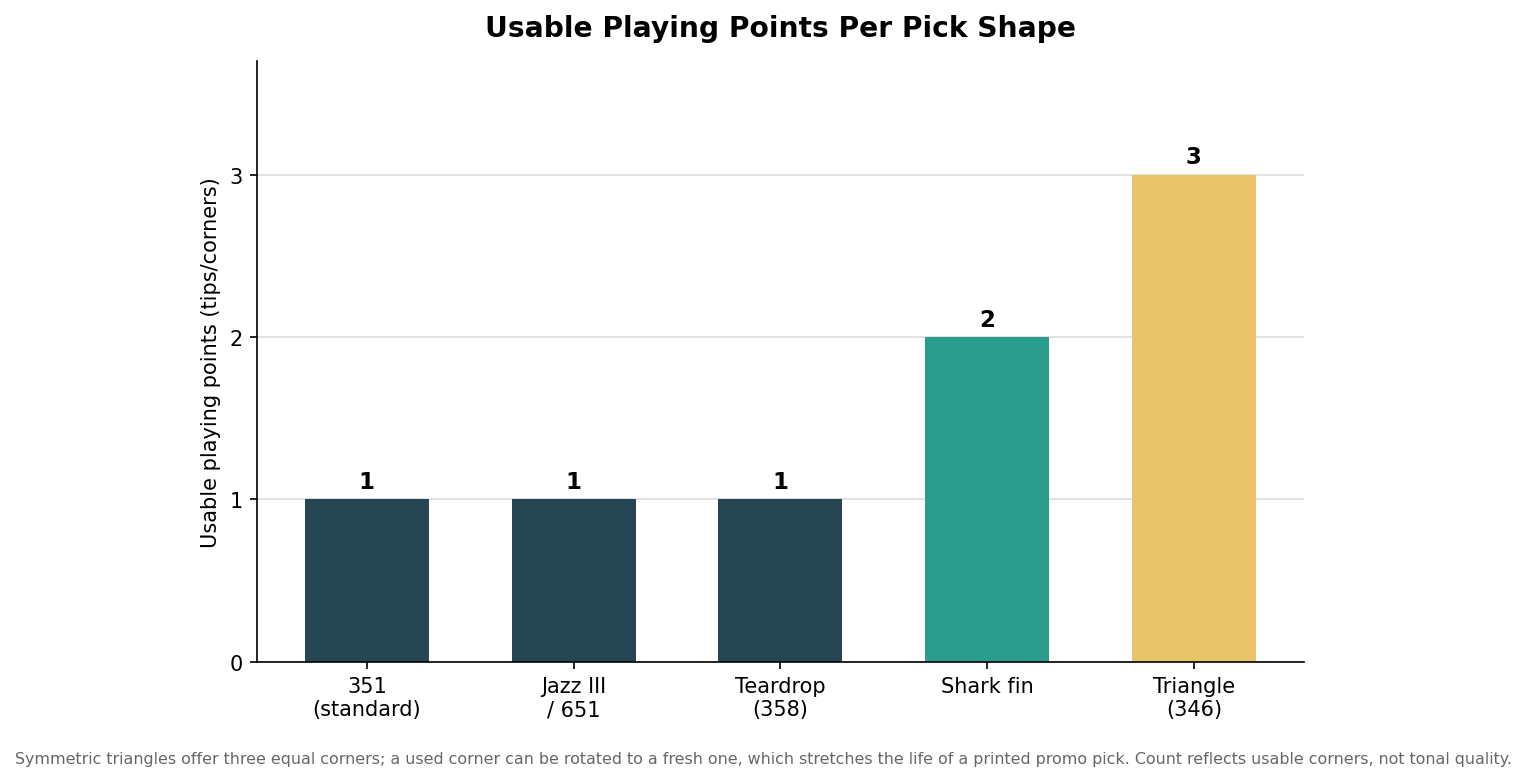
Related large shapes like the 355 and 385 follow the same logic in different flavors — the 355 leans bright and aggressive for rock and bass, while the 385 is a thicker, rounded-tip triangle built for durability and heavy strumming. All of them trade some single-note agility for body, projection, and grip.
Teardrops, shark fins, and specialty cuts
Between the extremes are the specialty shapes. The teardrop, including small elongated versions like the 358, is a narrow, agile pick that favors fine control and rapid single-note work, essentially bridging the gap between a 351 and a Jazz III. The shark fin is the multitool of the group: it pairs a normal rounded point for strumming with a serrated edge you can drag across the strings for texture and effect, giving it two distinct playing surfaces. These designs are less about being “better” and more about matching a specific technique, so they reward players who already know what feel they are chasing.
Shape is only half the decision: don’t skip gauge
Whatever outline you choose, thickness is the other half of how a pick plays, and the two interact. Picks are grouped into gauge classes measured in millimeters, from extra-light sheets under about 0.40 mm up through extra-heavy picks past 1.22 mm, with some novelty picks reaching several millimeters. Thinner picks flex and are forgiving for strumming chords; heavier picks stay rigid and drive single notes with more articulation, which is why sharp lead shapes so often come in heavy gauges. The reference below shows where the standard classes fall.
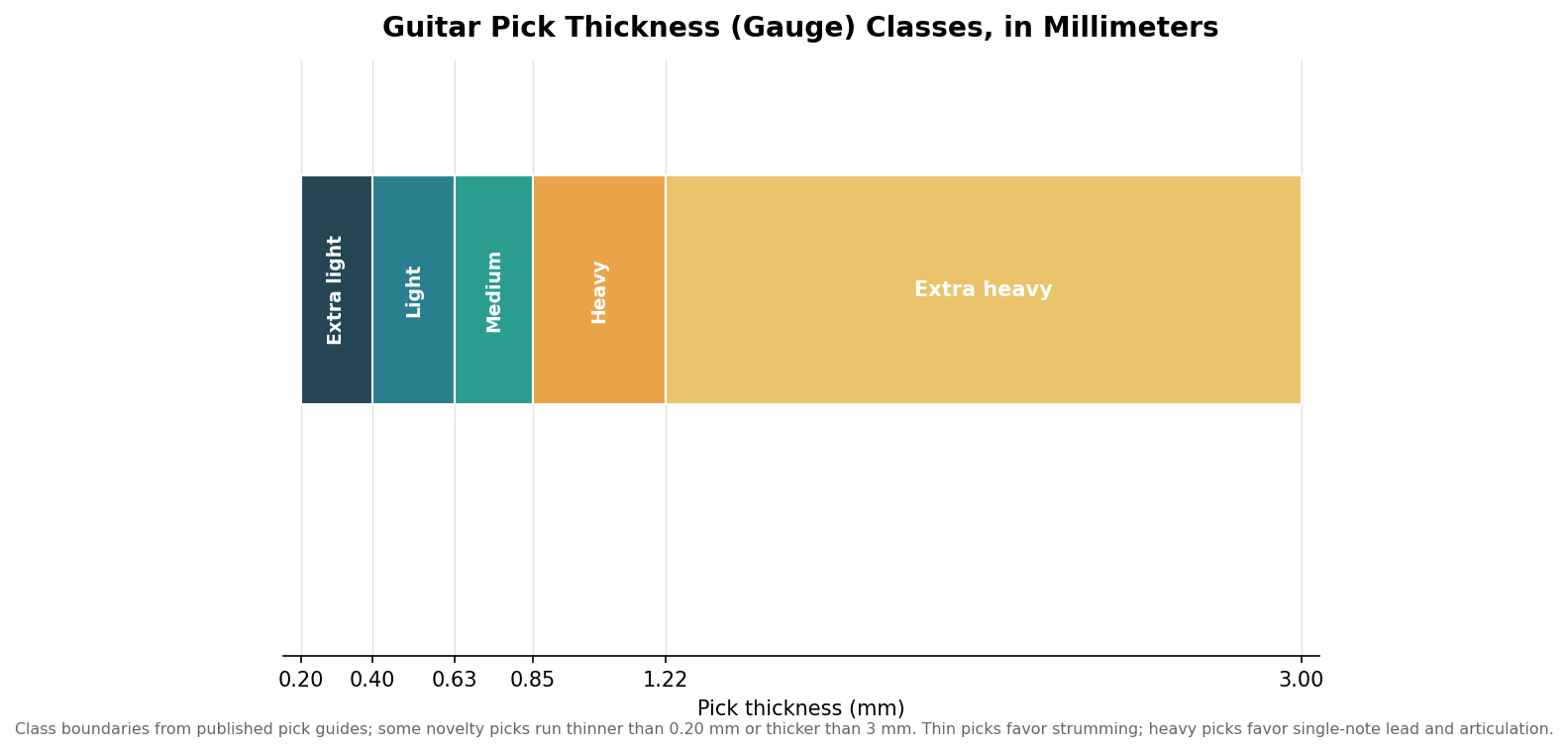
A useful rule of thumb: if you strum more, lean toward a larger shape in a lighter-to-medium gauge; if you play lead and want speed, lean toward a smaller pointed shape in a heavier gauge. There is no universally correct answer, and many players keep a couple of shapes on hand for different songs.
Choosing a shape for a custom or promo run
If you are ordering custom-printed or engraved picks, two shape factors matter beyond feel. The first is print area: larger bodies like the 351 and the triangle give your artwork the most room and reproduce a logo or text most legibly, while small Jazz-style picks constrain the design to a tight footprint. The second is usable life, where the triangle’s three corners genuinely stretch the value of each printed pick for giveaways and merch tables. For a band selling or handing out picks, a printed 351 is the crowd-pleasing default because it feels familiar to any player who catches one, while a triangle is the savvy pick when you want the artwork large and the picks to last.
Put together, the decision is not complicated. Start with the 351 unless you have a reason not to, size down to a pointed shape for speed or up to a triangle for strumming and print area, and then choose a gauge that matches how hard and how precisely you play. Match the shape to the hand and the gauge to the sound, and the pick disappears into the playing — which is exactly what a good one should do.